Independent AI & digital systems consultant

AI with Ty. Practical systems your business can actually use.

Websites, AI tools, and automations for small teams. Scoped tight, built to work, and handed over so your people can run it without me.

Independent practice · one person, start to finish

Taking on a small number of projects

3roles: advise, build, implement
2demos you can open right now
0long-term contracts

The work

Two systems you can use right now.

Not mockups or screenshots of somebody else's product. Open them, type into them, and watch exactly where the software stops and a person takes over.

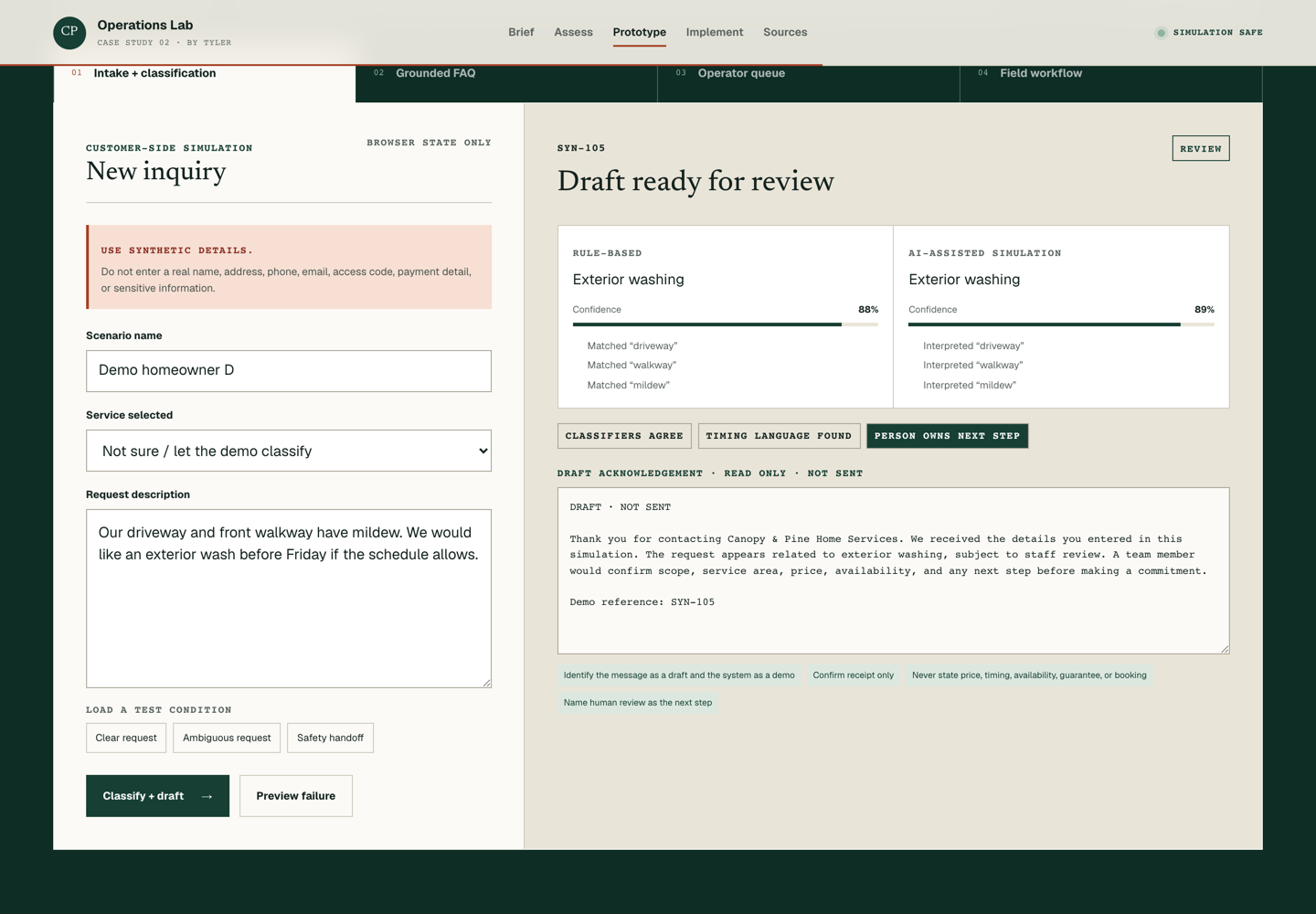
The operations lab: a new inquiry on the left, and on the right a drafted reply marked not sent, with rule-based and AI-assisted classifications compared side by side.
01Home services · operations

Canopy & Pine Operations Lab

A five-person field team was losing inquiries across phone, web, and text messages.

This sorts every request, drafts a reply, and hands each real decision to a person.

  • Reads an inquiry and drafts an acknowledgement in about a second
  • Shows the rule-based and AI results side by side, with confidence
  • Never quotes a price, books a slot, or sends a message on its own
Open the operations labFictional composite · synthetic data · nothing is sent
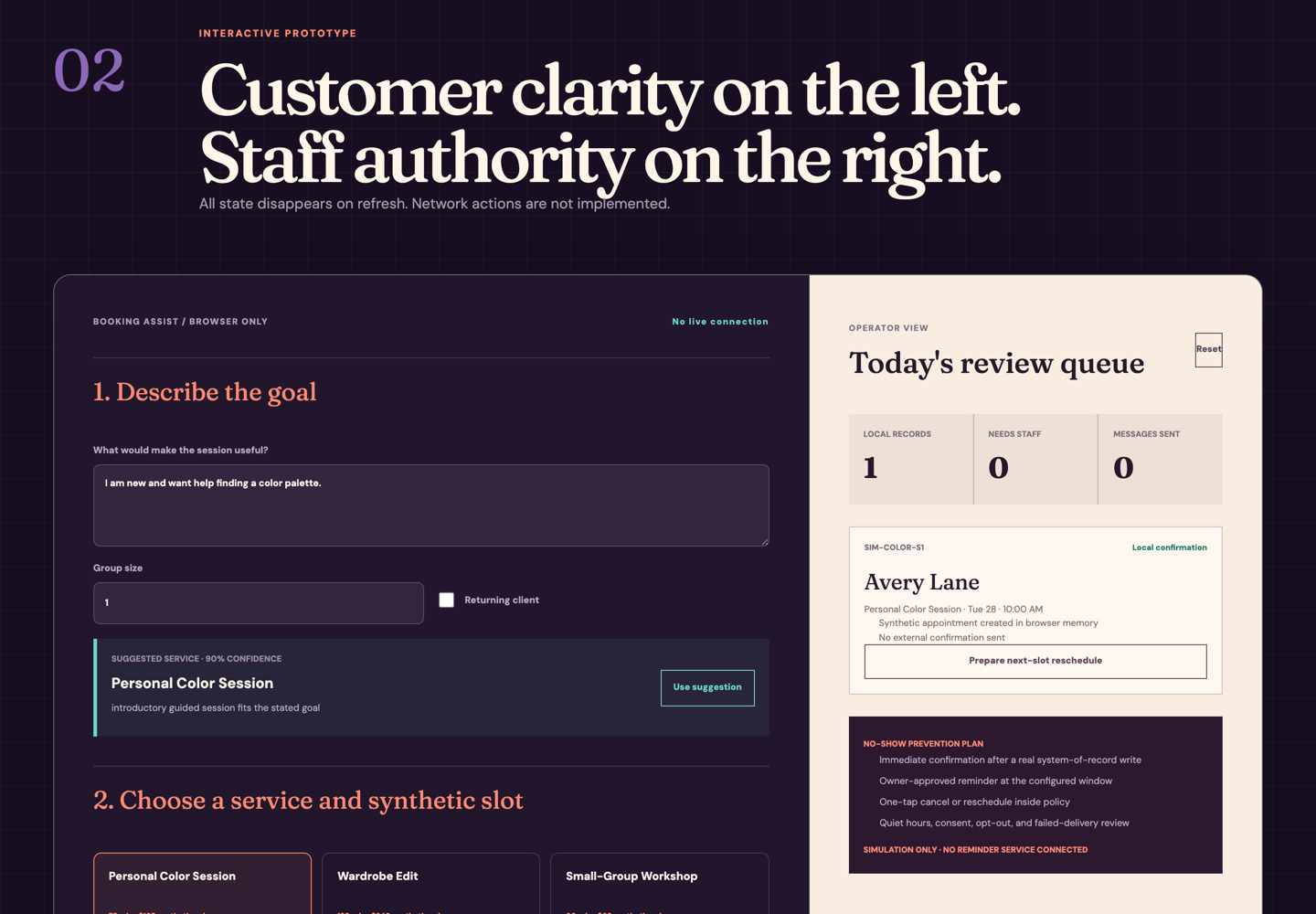
The appointment lab: a booking assistant suggesting a service at 90 percent confidence on the left, and a staff review queue with one local record on the right.
02Appointments · booking

Marigold Studio Appointment Lab

A studio was losing hours to booking back-and-forth, and money to no-shows.

This suggests the right service, holds a slot, and routes anything unusual to staff.

  • Recommends a service from what the customer actually asked for
  • Answers only from approved information, or stops and asks a human
  • Keeps every confirmation in the browser — no calendar or SMS is connected
Open the appointment labFictional composite · synthetic data · nothing is sent

Also: Miami Auto Brokers, a dealership website concept exploring inventory-led presentation. An independent concept, not client work, with contact actions deliberately disabled.

What I do

Three jobs. One person accountable for all of them.

Most people either tell you what to buy or build what you asked for. I do both, so the advice has to survive contact with a working system.

01

Advise

Work out what's actually worth doing before you spend money.

  • Map how the work runs today
  • Compare tools and vendors honestly
  • Say plainly when the answer is 'don't build this'
02

Build

Turn one clear idea into something real you can try.

  • Websites and landing pages
  • Working prototypes and internal tools
  • Small automations and AI tools on approved information
03

Implement

Make sure it still works after I leave.

  • Set it up and write down how it runs
  • Train the people who'll use it
  • Hand over accounts you own and control

Pricing

Four ways to start, with the numbers up front.

Every project starts with one workflow, one decision-maker, and a written scope agreed before any work begins.

Advise

Practical Systems Assessment

A map of how the work runs now, where it breaks, what's worth fixing, roughly what it returns, and the smallest next step worth taking.

$450–$1,200one-time

Build

Workflow Prototype

One working proof you can click through, built on test data, with the human handoffs drawn in and a written definition of done.

$1,200–$3,500one-time

Implement

Controlled Implementation

The real setup: configuration, documented integrations, tests, staff training, a fallback plan, and handover into accounts you own.

$2,500–$7,500one-time

Maintain

Defined Care Plan

Written monitoring, content, and improvement duties with a set update allowance. No 24/7 promise, because I'm one person.

$175–$650per month

Read this

These are planning ranges, not quotes. The real number comes after we talk through scope, what you're responsible for, what's excluded, and any third-party costs.

How it works

Four steps. You approve each one.

  1. 01

    We find the real problem

    Who does the work, what gets in the way, and what would actually be worth measuring.

    A short written brief
  2. 02

    We pick the smallest thing worth building

    I compare the practical options and tell you what to configure, what to build, and what to leave alone.

    A scoped recommendation
  3. 03

    I build it and you test it

    You see it working at agreed checkpoints, on realistic cases, before anything touches your customers.

    Something you can try
  4. 04

    I hand it over and train your team

    Written instructions, a walkthrough with the people who'll use it, and ownership of every account.

    Documentation and handover

Fit

Who this is for.

Worth a conversation

  • Your website no longer looks like the quality of your business
  • You answer the same customer questions every single week
  • You're stuck choosing between two tools or vendors
  • You want to test an idea before spending real money on it

I'll point you elsewhere

  • Anything touching regulated or highly sensitive data
  • Security audits or cybersecurity certification
  • Licensed accounting, tax, or legal work
  • Large enterprise platform engineering

Knowing where the edges are is part of the job. These need a specialist, and I'll say so early rather than take the work.

Ground rules

Useful automation needs edges.

Approved answers only

An AI tool answers from information you've reviewed. It doesn't invent prices, availability, or policy.

A person owns the exception

Anything uncertain or consequential goes to a human instead of being quietly resolved by software.

You control the accounts

Production accounts, logins, and final permissions stay in your name. Always.

The scope says what it isn't

Every project names what it doesn't cover, so nobody mistakes a working tool for a licensed opinion.

Behind the demos

The working materials are public too.

Editable templates, completed examples, and dated vendor research — the actual paperwork a project runs on.

Delivery toolkit

Eighteen materials, from first qualification call through training, handover, and the 30-day review.

Open toolkit

Vendor decision library

Thirty dated records across ten categories, with sources, comparisons, and CSV export.

Search vendors

Planning and delivery materials — not legal forms, guarantees, or claims about client results.

About

I came to this from finance, not from tech.

My background is finance and accounting: understand a process, test the assumptions, check the controls, and ask whether the money is likely to come back. That's the same question worth asking about any software you're about to buy.

It means I'm useful in the conversation before the build — which option is worth the money, which is worth the risk, and which one you should skip. Then I build the thing, document it, and leave your team able to run it.

A clear problem, a small build, and a handover that sticks.

Contact

Tell me what's getting in the way.

The business mailbox is still being set up. Until it's live, this planner stays entirely in your browser — nothing is sent, saved, or transmitted anywhere.

Contact pending · local preview only

Draft a future inquiry

Use this as a private scratchpad. Shape the request now, then send it across once the address is published.

Nothing previewed yet

Fill in the business and challenge fields to build a local summary. Nothing will leave this device.

Once the mailbox is published, this planner switches to a real contact path.